Three Years of Rural Futures: Reimagining Water, Land, and Livelihoods
Field irrigation channel pipeline work near Distributary 10 of Narayanpur Right Bank Canal in Karnataka. | Photo credit: Vraj Acharya
When WELL Labs started three years ago, the Rural Futures programme was created to answer a seemingly simple, yet deeply complex question: how do you increase rural incomes without further degrading water and land?
In our attempt to answer this question, we obtained multiple insights. We learned that increasing incomes is more about reducing risk than increasing yields; that water scarcity is often a problem of governance, rather than of physical availability itself; that markets determine whether diversification efforts survive. And, perhaps most importantly, we realised that meaningful change happens only when multiple systems shift together.
These three years have taught us that rural transformation is not merely an agricultural challenge. It is a systems challenge. Farmers make decisions within a web of constraints, including water access, labour availability, market risks, institutional gaps, and ecological decline. Changing only one of these without addressing or considering the others means the system will quietly pull everything back to where it was.
Furthermore, the transformations must be sustainable, which would involve fundamental redirections of current human-environmental relationships. However, many of these are ‘locked in’ to inequitable, unsustainable pathways. To address the foundational question of the Rural Futures programme, we followed a transformation lab (or T-Lab) approach spread across villages in Raichur district. Under this approach, we consider the regions as labs in which to test hypotheses, taking into consideration the interconnected constraints. T-Labs generate innovations that can overcome lock-ins and create seeds of change that can potentially have a transformative impact on the broader society towards sustainability. After considerable momentum in the Raichur T-Lab, we are now introducing this approach in Karnataka’s Chikkaballapur district as well.
We approached the Rural Futures programme in three stages. First, we sought to understand the system as it exists. Then, we began to imagine what it could become. Finally, we focused on building and institutionalising what actually works.
Year 1 – What Is
In the first year, our effort was centred on understanding constraints before attempting to effect change. Across canal command and dryland villages, we observed that farmers were not limited by a single problem, but by several reinforcing lock-ins that left them vulnerable to climate and market vagaries. Unequal access to irrigation in canal systems, dependence on water-intensive crops (e.g. paddy), declining soil health, rising input costs, the absence of reliable markets for alternative crops, and a high labour burden, especially on women, were all deeply interconnected realities.
We spent considerable time in villages conducting interviews, facilitating visioning exercises, and studying farming practices, water access, and socio-economic conditions. At the same time, we began implementing small pilots. With the help of grassroot partners like Prarambha, the work on tank restoration and lift irrigation revivals helped enable protective irrigation in dryland areas. Similarly, trench-cum-bund works were taken up through the Mahatma Gandhi National Rural Employment Guarantee Act, which improved soil moisture while generating rural employment. We also supported the revival of traditional intercropping systems, such as Akkadi Saalu, and introduced green manuring and other soil-regenerative practices. We also started early conversations around equitable water sharing and the need for collective approaches to irrigation management.
Crucially, in the first year, we identified the real problem. The issue was not the absence of solutions. Rather, it was the misalignment between available solutions and the systems into which they were introduced.
Year 2 – What If
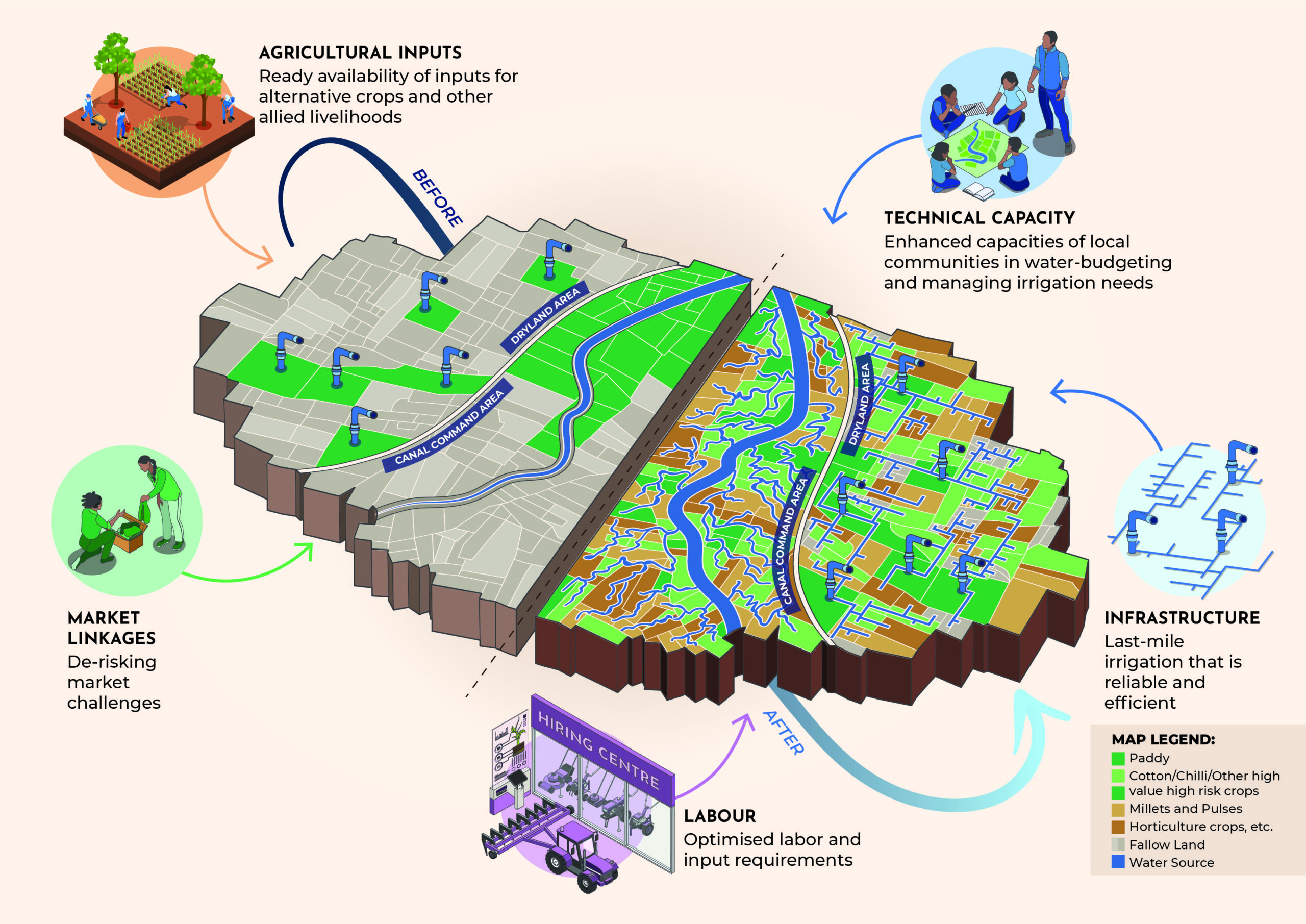
The Rural Futures programme’s five-lever approach.
Illustration by Aparna Nambiar
In the second year, once we understood the system better, we began asking what it would look like if this system worked differently. This phase was not about implementing projects but about testing pathways for systemic change. We realised that rural transformation cannot follow a solution-first approach. It requires working simultaneously on what we identified as the five levers that can bring about this change: irrigation infrastructure; community institutions and knowledge systems; labour and mechanisation; agricultural inputs; and market access.
This phase was also shaped by a growing ecosystem of partners across research, government, and grassroots implementation. In addition to grassroot partnerships, collaborations with government organisations (such as the Advanced Centre for Integrated Water Resources Management (ACIWRM)), and donors like DCB Bank, Nvidia, IHE Delft, IDRC and other research and implementation partners, helped bridge field insights with policy and technical systems.
In canal command villages, we initiated digital mapping and water budgeting exercises in Distributary 10 of the Narayanpur Right Bank Canal, and worked with farmers on participatory irrigation planning. We also helped develop the early designs for pipeline-based irrigation models. In dryland villages, we focused on reviving community irrigation systems and on using public funds to build water assets that expanded protective irrigation and reduced dependence on erratic rainfall.
Importantly, we recognised that infrastructure alone could not solve water challenges. Therefore, we supported the formation of water user cooperative societies; trained community hydrologists for village-level water planning; and built local capacity for irrigation and crop planning. Simultaneously, we studied labour demands across cropping systems, piloted labour-saving technologies, and began exploring entrepreneurship models around farm mechanisation.
Furthermore, to make sustainable agricultural transitions viable, we established bio-resource centres that enabled farmers to access alternative inputs (e.g. non-chemical bio inputs), seeds, and soil health practices. Many of these systems were managed by women’s groups, linking ecological sustainability with local livelihoods. To understand why crop diversification often fails, we studied mandi dynamics and trader relationships, and began designing aggregation and collective marketing strategies.
The shift in the second year was subtle but significant. We stopped implementing isolated activities and started redesigning interconnected systems.
Year 3 – What Works
By the third year, certain patterns had become clear. We understood that some approaches worked consistently when implemented together. This year was, therefore, about integrating, embedding, and scaling these approaches within the existing system.
Accordingly, we piloted pipeline-based irrigation models in canal command areas and institutionalised water budgeting and participatory planning tools. Protective irrigation expanded further across dryland villages. During this phase, we identified a critical learning: farmers value the reliability of water far more than the quantity.
This year also witnessed the clear shift of beneficiaries becoming system managers. Water user cooperatives became operational; community hydrologists were embedded within village systems; and farmers began co-designing and managing irrigation plans.
We also worked on building rural service economies. Village-level entrepreneurs were trained to run agri-machinery services, making mechanisation accessible as a service, rather than as an asset. Concurrently, bio-resource centres began serving hundreds of farmers, and women-led enterprises around alternative inputs became stronger. Efforts toward aggregation, value addition, and improved price realisation also gathered momentum, linking diversification strategies with market systems.
The third year further strengthened the critical insight that no single intervention can work in isolation; instead, aligned systems can.
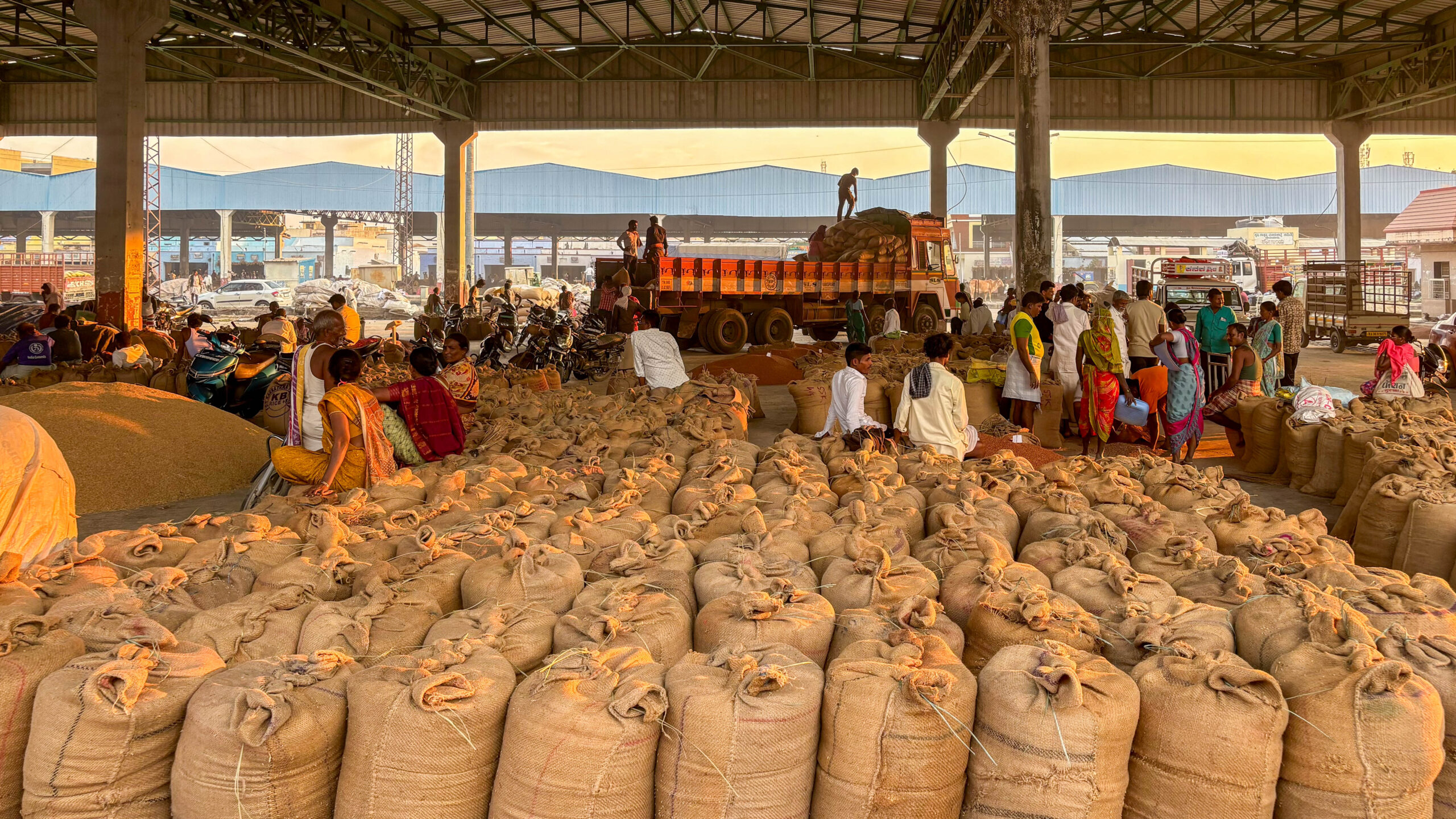
A scene from the Raichur Mandi.
Photo credit: Nabina Chakraborty
Year 4 – What Next
As the programme moves into its next phase, the focus is on scaling systems rather than expanding pilots. This includes expanding pipeline irrigation and water governance models across canal systems, deepening protective irrigation and water planning in dryland regions, institutionalising community hydrology, building rural enterprises around mechanisation and inputs, and strengthening farmer collectives and market linkages.
The aim is to anchor the Raichur T-Lab as a model for socially just rural transitions that integrate water, land, and livelihoods in a coherent manner.
Three years is a short time for systems change, but long enough to understand what can be possible. Rural transformation is not about scaling a single solution. It is about shifting deeply connected systems without losing their context and integrity.
The Rural Futures programme has empowered communities to co-create solutions; enabled institutions to manage resources collectively; and helped develop pathways for ecology and economics to move together.
The journey ahead is about taking these foundations forward carefully and thoughtfully.
Here’s to WELL Labs and the Rural Futures programme successfully completing three years!
Acknowledgements
Authored by Ashima Chaudhary and Syamkrishnan Aryan
Edited by Apuurva Sridharan
Published by Nanditha Gogate
Follow us and stay updated about our work: