
How Can We Scale Wastewater Reuse in Urban India?
WELL Labs, Swiss Federal Institute of Aquatic Science and Technology (Eawag) and Bangalore Apartments’ Federation organised a workshop titled Closing the Loop: Strategies for Decentralised Water Reuse in India.
The event, held at Bangalore International Centre on 9 January 2026, was the fourth in a series of workshops organised under the WaterReuseLab project. A wide range of stakeholders, including representatives from government agencies, research institutions, civil society organisations, startups, and resident groups explored how high-quality, affordable decentralised water reuse could be scaled to address urban water scarcity in Bengaluru and across India.
The event began with Dr Ram Prasath Manohar, Chairman of Bangalore Water Supply and Sewerage Board (BWSSB), delivering the keynote address.
Dr Manohar emphasised that treated wastewater must be recognised as a valuable resource, and that reuse needs to move beyond a compliance-driven approach. He highlighted that the city currently treats approximately 1,348.5 MLD of wastewater through 34 centralised sewage treatment plants. This water has the capacity to meet the majority of the city’s non-potable demands. Integrating decentralised STPs housed in apartment complexes and IT parks into a broader wastewater network can help mainstream wastewater reuse for commercial and industrial purposes. Dr Manohar concluded by emphasising that challenges in treated wastewater reuse is an opportunity for collaboration and reaffirmed the BWSSB’s commitment to positioning Bengaluru as a global model for urban water reuse and water security.
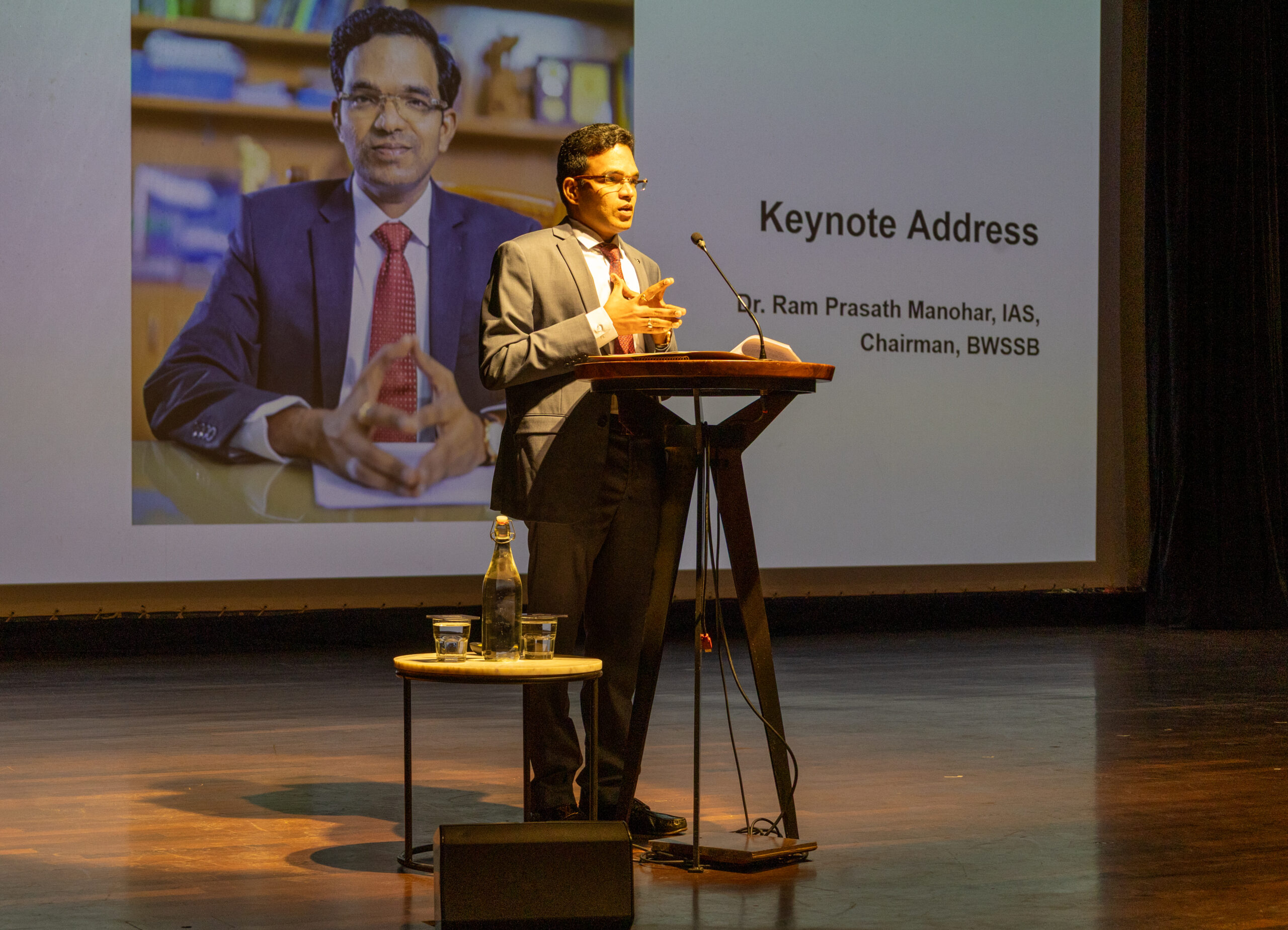
Dr Ram Prasath Manohar, Chairman of BWSSB, delivering the Keynote Address
The first plenary session had Mr Depinder Kapur, Head – Climate Centre for Cities, NIUA, deliver an address titled Policy Perspectives on Water reuse: Regulation, Integration and Scale.
Drawing from a recent study conducted by Centre for Science and Environment (CSE), he stated that Karnataka and Delhi currently lead the way in treated wastewater reuse, at approximately 49% and 43% respectively. Mr Kapur highlighted that urban policies and regulations often do not feature water reuse as a solution, and the ones that do focus on wastewater, often lack clarity on approach, process, scope, and timelines. He emphasised that the core aim of policy frameworks should be to enable and assure local reuse, particularly through decentralised systems.
Ms Gayathri Muraleedharan, Head of the Urban Water Programme at WELL Labs, presented a comprehensive, evidence-based assessment of the role of decentralised wastewater reuse in addressing Bengaluru’s growing water stress in Plenary 2.
Drawing on spatial analysis, modelling exercises, and large-scale field surveys, Ms Muraleedharan explained that Bengaluru is expanding outside the coverage of centralised water and sewerage networks. Hence, these areas are heavily reliant on groundwater. She made a case for decentralised reuse by highlighting that 88% of potential users are located within a 2 km (15-minute) radius of existing or planned DSTPs. She further emphasised that the current demand for treated water is nearly three times the supply available from decentralised systems, indicating substantial untapped potential.
Dr Christian Binz from Eawag followed with a presentation on insights from the WaterReuseLab project.
Dr Binz positioned Bengaluru as a potential global lighthouse case, due to its unique ecosystem where acute water stress, a large number of decentralised STPs with uneven performance, and an emerging ecosystem of innovators, service providers, and researchers co-exist. This makes the city both a high-risk and high-opportunity case for system transformation. The WaterReuseLab identified key system failures that prevent the scalability of DSTPs: fragmented governance, lack of fit-for-purpose water quality standards, immature reuse markets, weak incentives for residential associations and developers, insufficient monitoring practices, and low confidence among users and decision-makers. Mr Binz stressed the need for a system orchestrator that can align actors and interventions to scale treated wastewater reuse.
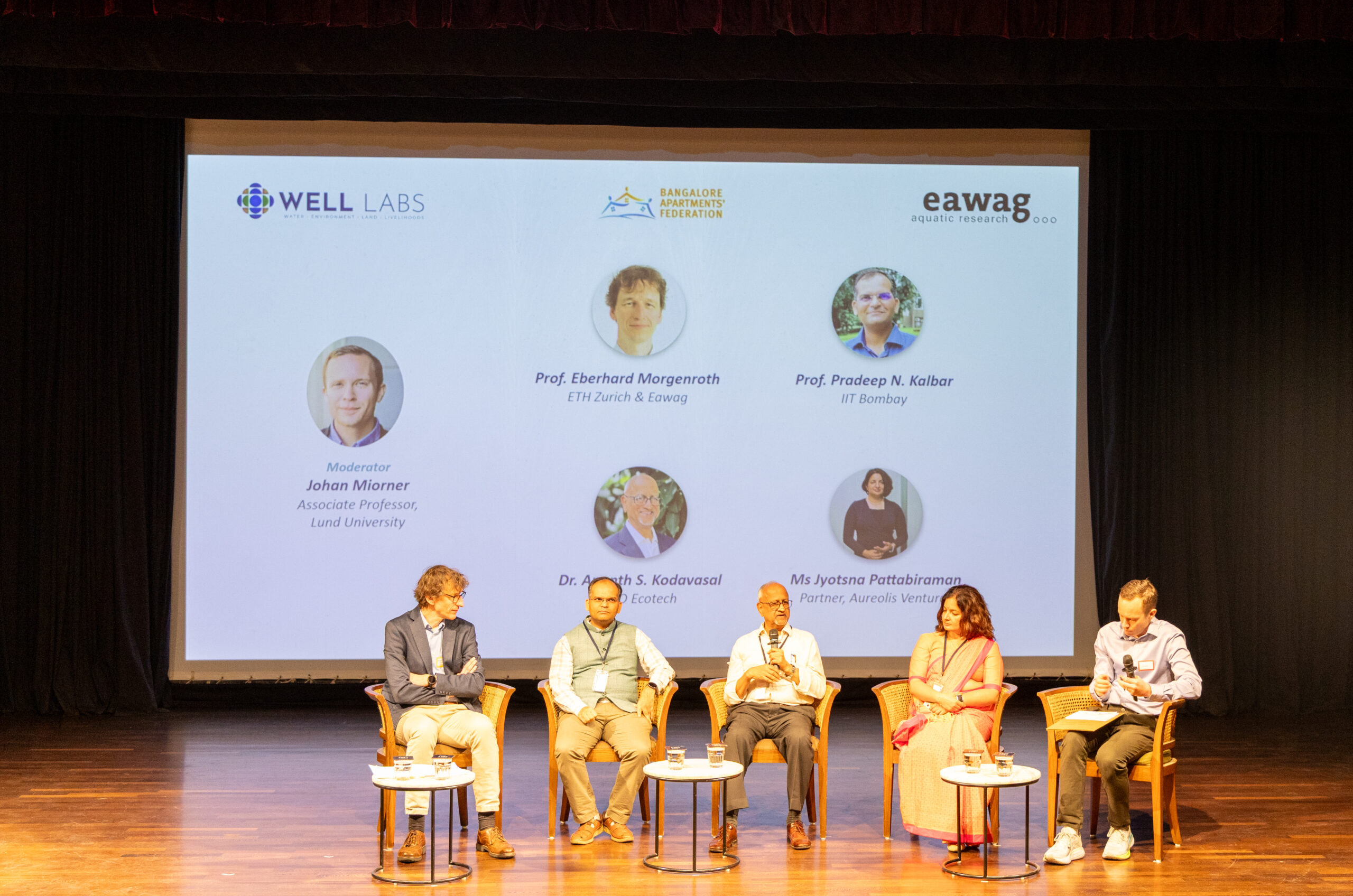
Panel 1 discussed how robust and affordable treatment solutions, reliable monitoring systems, and a supportive business ecosystem around wastewater reuse can be developed
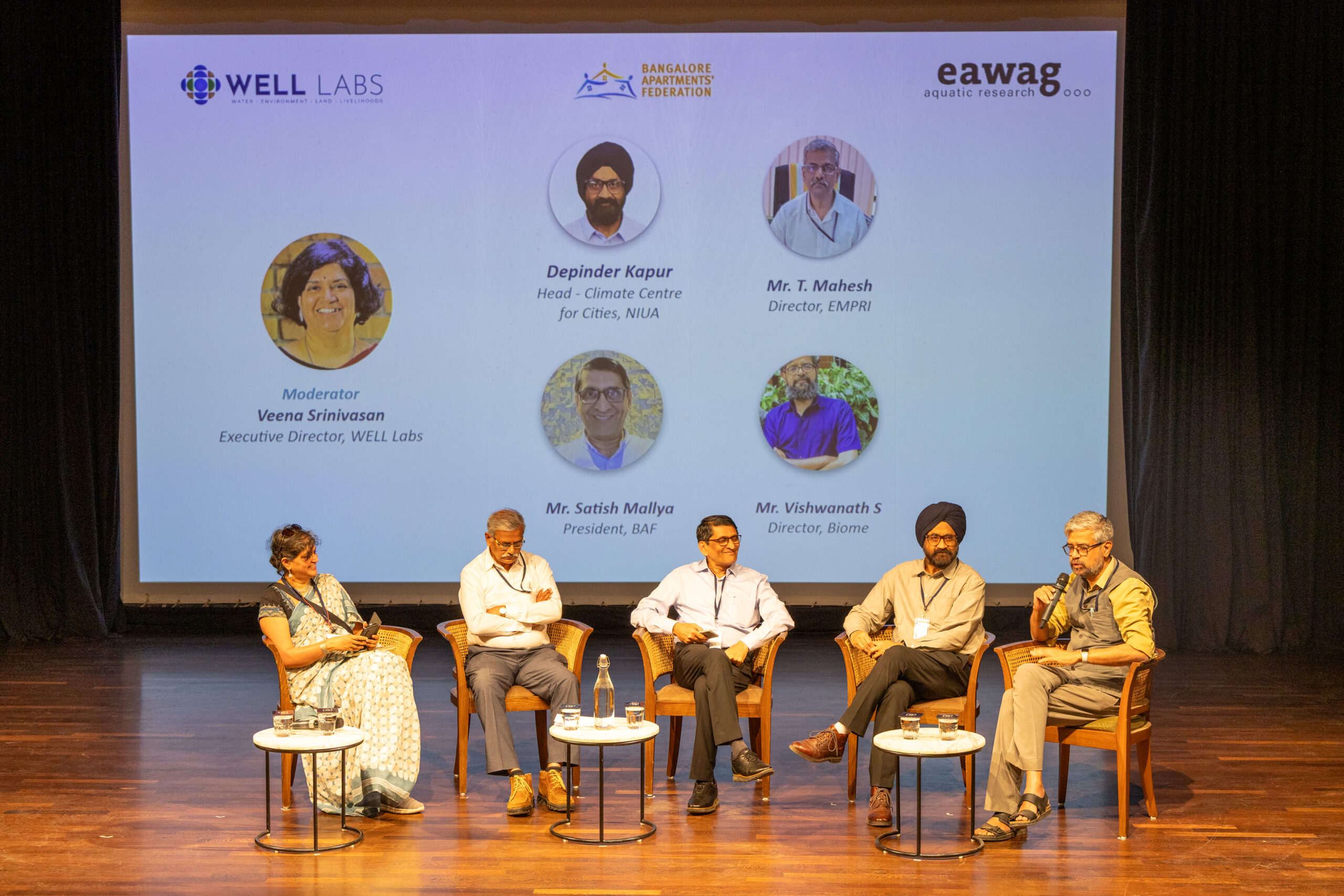
Panel 2 discussed how regulatory frameworks and standards can be strengthened, and policy gaps for decentralised water reuse can be addressed
The first panel discussion, titled Technology, Monitoring, and Business Models: Developing Robust and Affordable Treatment Solutions, Reliable Monitoring Systems, and a Supportive Business Ecosystem, was moderated by Dr Johan Miörner, Associate Professor, Lund University.
Panellists included Prof. Eberhard Morgenroth, ETH Zurich & Eawag; Prof. Pradip N. Kalbar, IIT Bombay; Dr Ananth S. Kodavasal, Ecotech Engineering Consultancy; and Ms Jyotsna Pattabiraman, Aureolis Ventures. This session examined how technology choice, monitoring reliability, and business models should be jointly designed to enable robust, affordable, and scalable decentralised wastewater reuse systems. Speakers emphasised that system failures in decentralised STPs are rarely due to a single factor. Instead, they arise from misaligned technology selection, weak operations and maintenance, insufficient monitoring, and poorly structured economic incentives.
During the lunch break, participants interacted with leading water experts at nine breakout tables on key systemic issues around wastewater at the World Café.
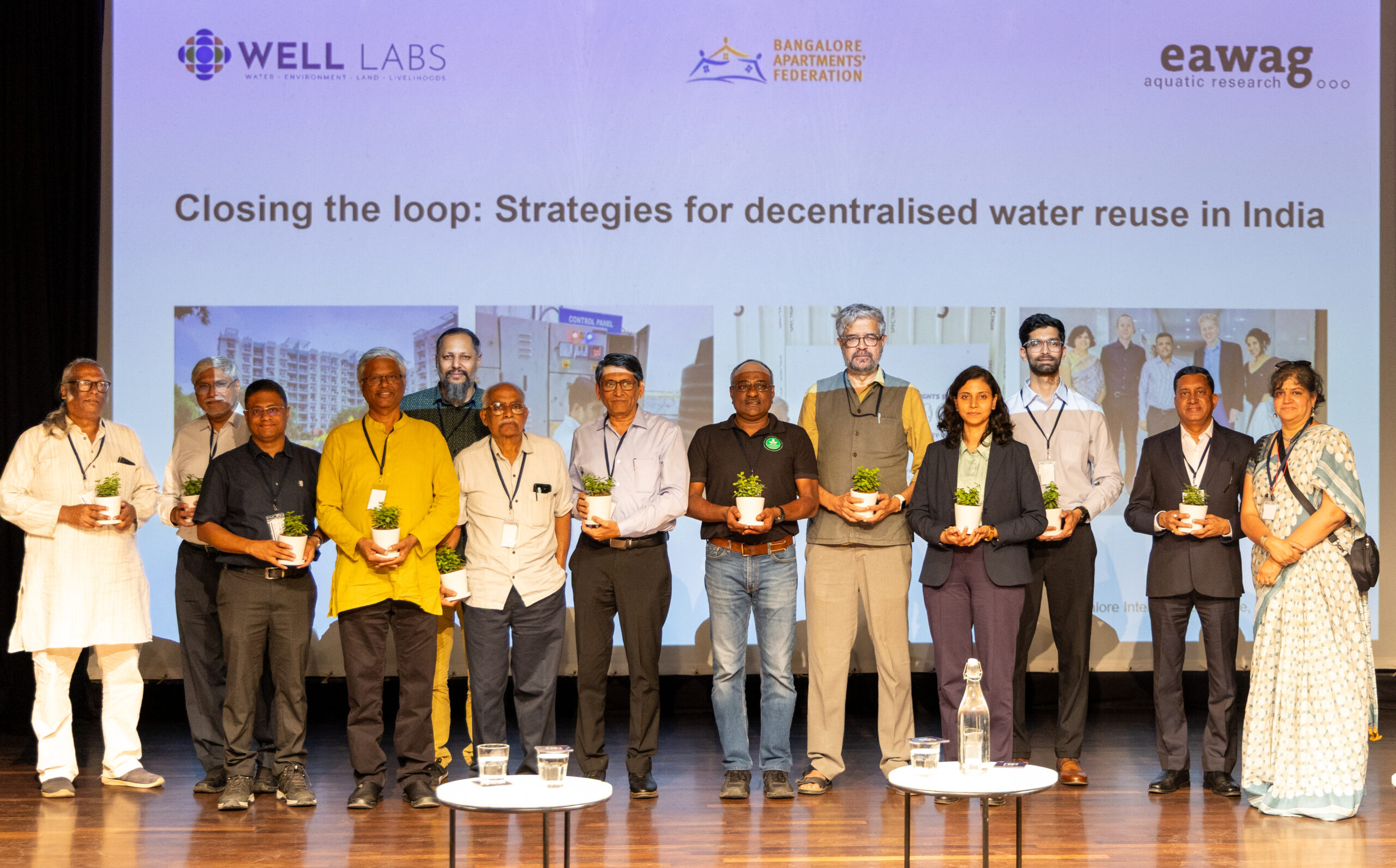
Water experts at the World Café
The second panel discussion, titled Strengthening Regulatory Frameworks, Standards, and Addressing Policy Gaps for Decentralised Water Reuse, was moderated by Veena Srinivasan, Executive Director, WELL Labs.
Panellists included Mr Depinder Kapur, NIUA; Mr Satish Mallya, Bangalore Apartments’ Federation; Mr. Vishwanath S, Biome Environmental Solutions; and Mr. T Mahesh, EMPRI. The session highlighted the various ways in which people viewed decentralised STPs: from an example of state failure in treating wastewater in a centralised manner to an untapped resource in addressing water security challenges. Speakers highlighted the role of unplanned urban development in the establishment of DSTPs, the need to generate fit-for-purpose treated water, incentivise construction of DSTPs, and build capacity in STP operations and maintenance.
The conversations at the event reinforced that, decentralised STPs, when integrated with integrated with centralised systems, can function as a city-wide resource that reduces pressure on freshwater sources and strengthens urban water security.
A key insight was the importance of fit-for-purpose reuse, where water quality is matched to end use, helping keep systems practical, affordable, and sustainable.
About Eawag
The Swiss Federal Institute of Aquatic Science and Technology (Eawag) is one of the world’s leading aquatic research institutes. With its professional diversity, close partnerships with practitioners and an international network, Eawag offers an excellent environment for the study of water as a habitat and resource, for identifying problems at an early stage and for developing widely accepted solutions.
About Bangalore Apartments’ Federation
Bangalore Apartments’ Federation (BAF) is a Federation of Apartment Owners’ Associations (AOA) and Residents’ Welfare Associations (RWA) in Bangalore. It was formed in 2014 to represent and protect the interests of Apartments & Resident Welfare Associations across Bangalore.
About WELL Labs
WELL Labs is transforming water systems at scale across India through research, partnerships, and collective action. WELL Labs takes on audacious challenges, tackling complex, ‘wicked’ problems where we believe there is a reasonable chance of success and a high potential for social returns. Its work is science-led and community-focused, addressing the interconnections between water, environment, land, and livelihoods. To create impact at scale, WELL Labs embeds solutions within governments, works with corporates and market players, and collaborates with civil society and active citizens. Based in Bengaluru, WELL Labs is a part of the Institute for Financial Management and Research (IFMR) Society.
Follow us to stay updated about our work.
Related Posts
Related Posts
-
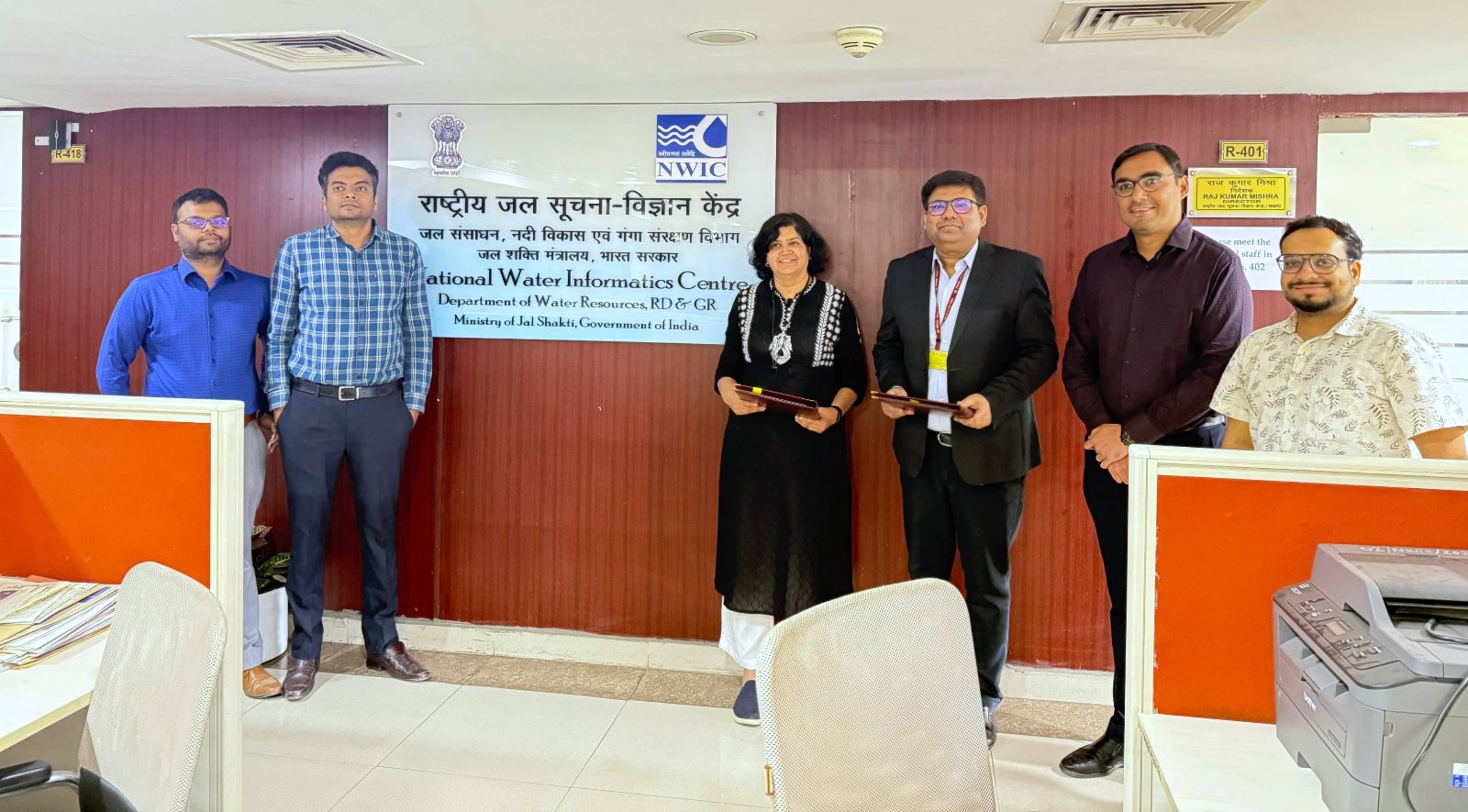
WELL Labs signs an MoU with the National Water Informatics Centre, Ministry of Jal Shakti
This partnership is a significant step toward enhancing water data ecosystem of India.
-

WELL Labs’ Values: Fostering Deep Empathy, Problem-First Thinking, and Scientific Excellence, Among Others
Learn more about the values the WELL Labs team aims for in its work of transforming water systems across India
-

Welcome Back to the Water Data Podcast!
The Water Data Podcast is a talk show on the science, systems, and stories of water hosted by Veena Srinivasan. Every other Tuesday, sit down and listen to researchers, innovators, government offic...
-
Governing Water Resources with Dr Somasekhar Rao
Dr Somasekhar Rao has a wide-ranging discussion with host Veena Srinivasan on the first episode of Season 2 of the Water Data Podcast.
-
Groundwater and Markets with Dr Soumya Balasubramanya
Dr Soumya Balasubramanya has a wide-ranging discussion with host Veena Srinivasan on the second episode of Season 2 of the Water Data Podcast.
-
Flood Science and Management with Dr Günter Blöschl
Stockholm Water Prize 2025 winner Dr Guenter Bloeschl shares a masterclass on the science and management of floods on the third episode of Season 2 of the Water Data Podcast