
When Power on Paper Isn’t Power in Reality: Women’s Leadership in Panchayati Raj Institutions
A significant proportion of elected women representatives experience proxy participation, where male relatives influence or control decision-making in Panchayats. This is a representative image. Photo credit: Nabina Chakraborty
The 73rd Constitutional Amendment, which came into effect in 1993, granted constitutional status to Panchayati Raj Institutions (PRIs). One of the key features of this amendment was the reservation for women in these institutions, introduced to correct centuries of political exclusion, and ensure that local governance includes all voices.
More than three decades on, women’s representation in Panchayats has increased. Today, India has over 1.4 million elected women representatives in PRIs or Rural Local Bodies, constituting nearly 46% of Panchayat members (Ministry of Panchayati Raj, 2024).
On paper, this represents one of the largest experiments in political inclusion in the world. Yet, the exercise of power remains deeply unequal.
Field observations and engagement with Panchayat representatives in Devadurga and Sirwar taluks of Raichur district, Karnataka, brought to fore a concerning reality: though many women hold elected office, they do not exercise real decision-making authority.
This gap between legal power on paper and exercising authority on ground remains one of the most critical challenges confronting decentralised governance.
The Gap Between Representation and Authority
Legally, women Panchayat representatives possess full authority over planning, budgeting, and programme implementation. However, patriarchal norms, lack of experience, institutional gaps, low literacy, lack of training, social pressure, and limited institutional support lead to a significant proportion of women being unable to exercise independent decision-making power (UN Women, 2018).
In practice, political power and decision-making shifts away from elected women. It moves out of the Panchayat office and into domestic spaces, where male family members, most commonly husbands, sons, or brothers, exercise influence without any constitutional legitimacy.
Indeed, a significant proportion of elected women representatives experience proxy participation (particularly during their first term), where male relatives influence or control decision-making in Panchayats (Kumar & Ghosh, 2024). In regions such as Devadurga taluk, this pattern is woven into everyday governance practices and is rarely questioned. Control is normalised through gradual, socially accepted shifts of authority.
Experiences from Devadurga and Sirwar
Our interactions in the field in Devadurga and Sirwar illustrate how this dynamic unfolds in practice.
Lakshmamma: Administrative Presence, No Voice
Lakshmamma (name changed) was an elected Panchayat member from Devadurga. She attended meetings regularly and also signed official documents. Yet, in discussions, her voice was rarely heard. Instead, it was her husbands’ that was the decisive factor.
‘My name is there, my signature is there. But the discussions happen elsewhere’, she shared. Officials routinely deferred to her husband, assuming he ‘understands [political matters] better’.
Shantabai: Authority Displaced by Informal Expertise
Despite being elected as Sarpanch and holding the highest formal authority in the Panchayat, Shantabai found herself sidelined in practice. Her limited exposure to and familiarity with administrative processes was framed as a limitation, which created a space for her son to assume control over decision-making. Over time, this informal shift of authority became normalised, with villagers and officials bypassing her and engaging directly with her son.
‘Everyone knows whom to approach if work has to move faster’, she said. She retained legal accountability, but lost operational control; an exclusion masked as ‘support’.
These experiences illustrate how perceived deficits in administrative and procedural competence are often used to legitimise the marginalisation of elected women representatives, rather than prompting institutional efforts toward capacity-building and skill enhancement.
Leadership Training
Accordingly, to arm women with the competence and confidence necessary to wield official power, WELL Labs, in collaboration with IWWAGE, conducted a series of capacity-building and leadership training sessions in January and April 2026, in selected villages of Raichur. This effort was supported through existing institutional structures, such as NRLM, MGNREGA, Gram Panchayats, and Anganwadi teachers.
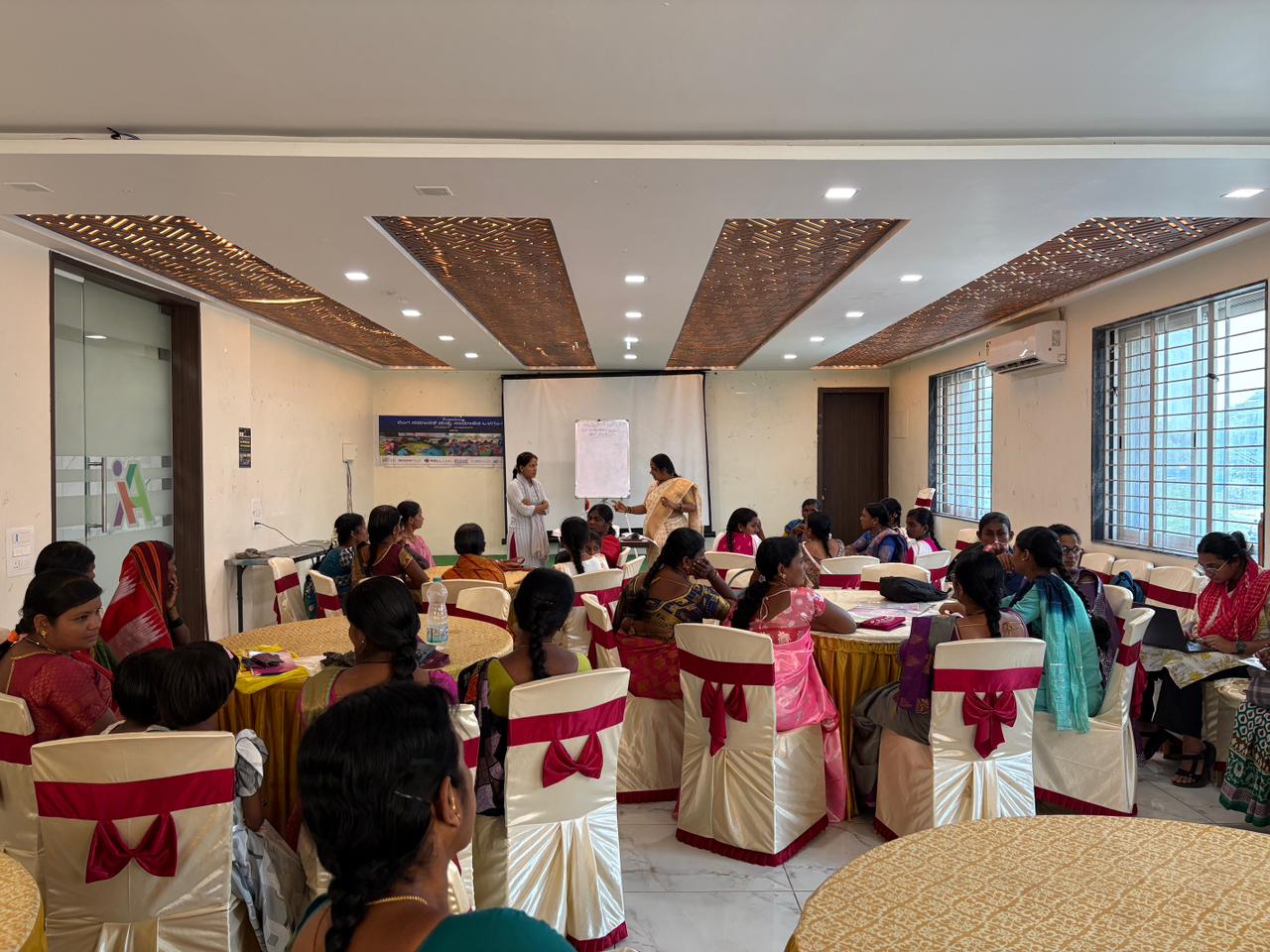
A still from the Leadership Training session conducted by WELL Labs, in collaboration with IWWAGE.
Photo credit: Nanditha Gogate
Prarambha, a development organisation, provided field support. Women who were embedded in the existing institutional structures and those who were vocal, motivated, and desirous of pursuing community-level change, were selected.
Primarily, the training aimed to strengthen women’s ability to:
- understand power, patriarchy, and entitlement.
- recognise how their struggles are systemic, not individual.
- build confidence to claim their rightful space in public institutions.
- navigate Panchayat processes and schemes with clarity.
- view themselves as equal stakeholders in governance.
These sessions enabled women to view their personal experiences (such as not receiving pensions/payments on time, and not being informed of important events) as institutional barriers, which was an important first step in reclaiming their rightful authority.
What Women Revealed During the Training
The sessions created a safe space for women to articulate the struggles they usually suppress. During the course of the training, several stories emerged that revealed how access, whether to institutions or positions of power, is restricted not only within families but also within institutions.
First, women are intentionally kept out of Panchayat processes. Multiple participants reported being not informed of Panchayat meetings, despite holding cadre roles under MGNREGA or SHGs. Information often flowed selectively through men or through networks shaped by gender and personal biases. Additionally, they were not allowed to attend meetings alone or without their male relatives.
Second, interpersonal and social hierarchies lead to widening communication gaps. Women pointed out that gatekeeping of power by influential actors within families, networks, or Panchayat secretaries created layers of silence between them and formal institutions.
Finally, institutional exclusion feels personal until they realise it is systemic. Many women initially thought, ‘it’s happening only to me’. However, during group discussions, they realised these were shared experiences rooted in structural patriarchy.
This collective recognition was a turning point for many participants.
Strengthening Women’s Ability to Navigate Power
The training sessions were designed to increase awareness and enable women to build strategies to challenge these barriers. Consequently:
1. Women began identifying themselves as rightful stakeholders. After understanding legal entitlements, several participants said, ‘If a meeting is happening, we have the right to be informed. We are not doing them a favour by attending’. This shift from internalised doubt to claiming space is foundational for political empowerment.
2. Women recognised the value of solidarity through collective spaces. While familial struggles differ, institutional barriers are shared. This insight helped women strategise collectively, whether it was demanding meeting notices, accessing schemes, or questioning biased officials.
3. Women connected personal experiences with systemic patterns. By understanding power, patriarchy, and climate vulnerability, women recognised the larger forces shaping their exclusions. This reduced self-blame and increased their sense of agency.
Driving Real Empowerment
The cases of Lakshmamma and Shantabai, when viewed in conjunction with insights from the leadership sessions, reveal a clearer picture of how such instances become normalised. That there is a large chasm between representation and assertion of authority is apparent. Bridging this gap requires:
- Continuous leadership-building, not one-time training
- Mentoring first-term women representatives
- Clear legal norms restricting proxy governance
- Engagement with men as allies rather than as alternative power-holders
- Community sensitisation to legitimise women’s public leadership
In particular, engaging men as supportive partners rather than informal decision-makers is crucial. The attitudes of husbands and male relatives strongly influence the exercise of authority. Thus, when men act as allies, offering support when needed but allowing elected women to make decisions, women representatives gain the confidence and space to exercise their leadership.
Conclusion
Experiences from Devadurga, Sirwar, and the leadership training reveal a simple truth:
Constitutional provisions alone cannot dismantle social power structures.
Only when women understand their rights, recognise systemic barriers, and gain the confidence and skills to challenge them individually and collectively can governance become truly democratic. Women must not only occupy seats but also exercise the authority those seats promise. Leadership training is one essential pathway toward making the shift from power on paper to power in practice. Without sustained capacity-building, representation risks becoming symbolic.
Acknowledgements
The authors are grateful to the women of Devadurga and Sirwar for allowing us to observe and document their lives and experiences. We also extend our sincere gratitude to Prarambha, our civil society organisation partner; anganwadi teachers of the region; and to the government departments that made this work possible: NRLM, MGNREGA, and Gram Panchayats.
This work is part of the Gender Equality and Social Inclusion (GESI) component supported by CLARE’s CLARITY project, IHE Delft (Remote Sensing for Communities), and DCB Bank CSR across different villages in Karnataka’s Raichur district.
About CLARE
CLARE is a UK-Canada framework research programme on Climate Adaptation and Resilience, aiming to enable socially inclusive and sustainable action to build resilience to climate change and natural hazards. CLARE is an initiative jointly designed and run by the UK Foreign, Commonwealth and Development Office and Canada’s International Development Research Centre. CLARE is primarily funded by UK aid from the UK government, along with the International Development Research Centre, Canada.
About CLARITY
Climate Adaptation and Resilience in Tropical Drylands (CLARITY), a research project under CLARE, is building equitable, sustainable, and climate-resilient development pathways in tropical drylands. This Global South-led project will result in the creation of long-term assets (data and tools) and capacities to achieve transformational change.
Authored by Divyashree Karkada and Parvathy Prasad
Edited by Apuurva Sridharan
Published by Apuurva Sridharan
Follow us and stay updated about our work:
Related Posts
-
Raichur Land Restoration Pilot: How We Studied the Local Context
-
Field Notes from Sittilingi Valley: How a Farmer Collective Addresses Both Healthcare and Agrarian Distress
The Sittilingi Organic Farmers Association (SOFA) shows how collectives founded on strong community values can benefit small and marginal farmers and the local ecology.
-
Soil Workshop in Raichur: Farmers Keen on New Methods to Rebuild Soils
Around 35 farmers attended the two-day workshop held in Raichur’s Devadurga taluk to learn about how they can test and improve soil quality,
-
Part 1: Journey Mapping to Plan the Future of Mukkanal’s Farmers
Through journey mapping, farmers can have a say in the blueprints of their own progress
-
Part 2: Livelihood Lessons and Insights from Journey Mapping in Mukkanal
A journey mapping exercise gave us a deeper understanding of livelihood patterns, challenges, and the impact of land degradation on households in our land restoration pilot site
-
Explainer: How Green Manure Can Help Degraded Farmlands Sustain Themselves
The traditional agricultural practice of green leaves manure involves creating manure and fertiliser from natural, homegrown plants as sources of various nutrients for soil