
Matching External Commitments to Internal Accountability
From the WELL Labs launch
This is Part 2 of a seven-part series on our learnings from running WELL Labs for three years. You can read Part 1 here
WELL Labs is an ‘impact-first’ non-profit within the IFMR-Krea university ecosystem. We are transforming water systems at scale across India through research, partnerships, and collective action.
To this end, we intend to be accountable and transparent.
Systems transformation needs a strategy and a plan to execute it
Our systems transformation work at WELL Labs is structured around goals. Each goal represents a complex problem that we aim to solve. For each goal, we have one or more theses or approaches to solving the problem underpinned by a theory of change – why we believe the approach will work.
Each thesis is accompanied by a roadmap. The roadmap is simply documented as a story of how the solution will unfold over the next decade. It is then broken up into a set of outcomes or milestones to be achieved along the way. Each outcome is associated with a hypothesis – how the activities and outputs we generate will result in the desired outcome or milestone. This in itself is pretty common. Most organisations have well-documented theories of change that form the basis of grant proposals and 5-year plans.
In general, outcomes are outside our control; activities and outputs are within our control. They are linked by hypotheses
A non-profit organisation aims to transform systems over which it has very little control. We promise this to donors. Yet we cannot guarantee that the activities we undertake will result in change (training programmes will produce more capacitated people who can actually earn a better living, government engagement will shift policy, etc.).
At best, we have a solid hypothesis (and unreasonable hope). If we do activity X and produce output Y, it will result in outcome Z. In the non-profit sector lingo, these hypotheses are part of the ‘theory of change’. Ideally, hypotheses are based on reliable prior evidence supporting the theory. These could be based on surveys, what’s worked in other sectors, psychological theory, whatever.
The bigger challenge is: how do these translate into internal incentive systems? In other words, how do we ensure our internal systems are robust? We are promising donors actual impact. How do we ensure our culture, incentives, training, and internal systems are optimised to deliver outcomes rather than outputs?
We find that most non-profits (including ourselves) struggle with this. Unlike the private sector, where success is measured by profit, creating impact in the development sector tends to take longer than annual performance review cycles. And the challenges don’t stop there. Making an impact is far harder than it looks, as government processes exist for a reason, often because they serve particular groups of people. Proving that impact has actually been achieved is harder still. When the goal is large-scale change over 3–5 years, how do you know if you’ve made the ‘right’ amount of progress in Year 1?
In the absence of robust systems, it is all too easy to become performative.
The biggest gap that many non-profits face is that the theory of change is never fully operationalised. It stays at the proposal stage or as a document. But it doesn’t translate to day-to-day operations. Importantly, as the organisation grows beyond 50 people, with lots of entry-level staff who come from very different organisational cultures, it is incredibly hard to communicate the mission and theory of change down to the junior-most staff member.
Here is how we are trying to overcome this.
Each year, we set ‘objectives and key results’ to operationalise our theory of change
The objectives and key results (OKR) framework by John Doerr is a goal-setting and performance management system used by for-profit organisations to align teams around clear priorities and measurable outcomes.
In our non-profit interpretation of OKRs, an objective is a qualitative, ambitious statement describing what you want to achieve (the direction or goal), while key results are a small set of specific, quantitative indicators that measure progress toward that objective.
We then break up the team’s OKR down to individual OKRs in a massive spreadsheet. The framework helps ensure alignment and accountability.
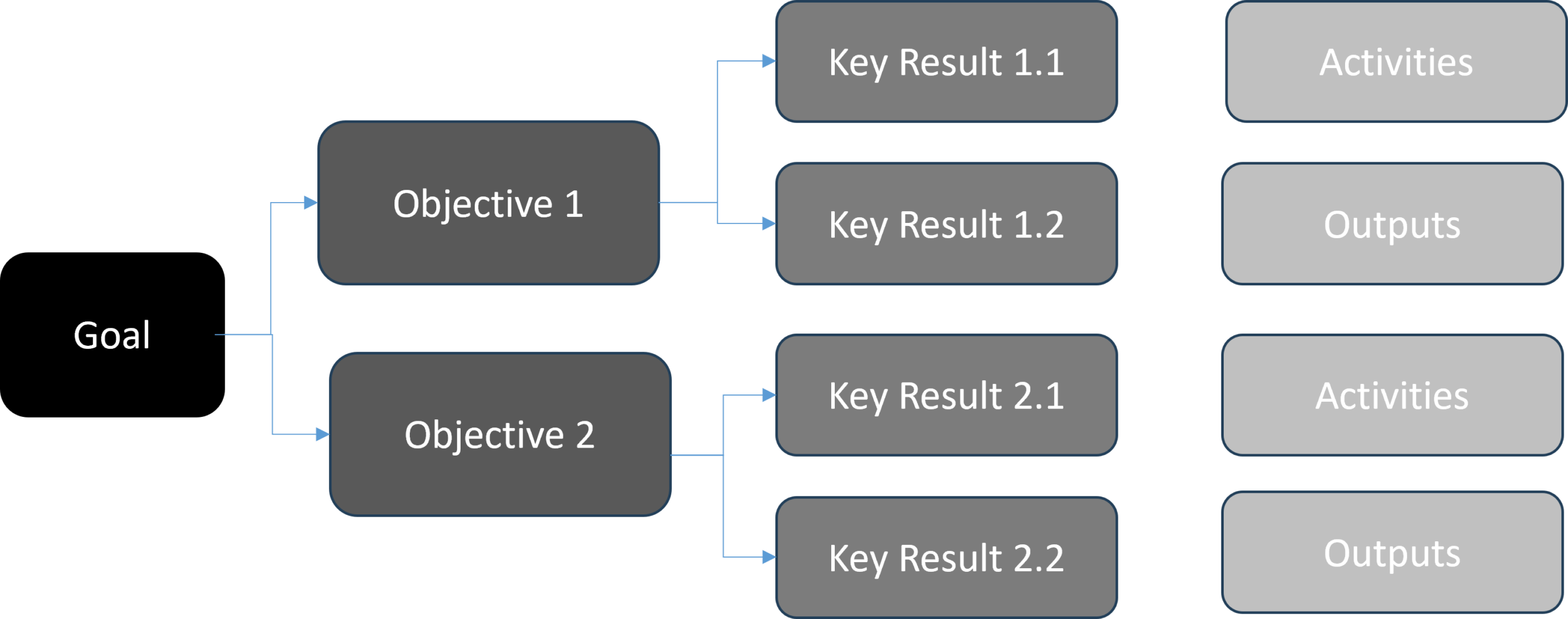
OKRs in the non-profit context are not that different from the theory of change. In fact, goals = impact, objectives = higher-level outcomes, key results = lower-level outcomes. The only difference is the emphasis on setting up systems to achieve them.
Key results are achieved through outputs and activities. Activities are things we do to make outcomes happen. Outputs are documentation of those activities.
The emphasis on outputs is a key difference between the private and non-profit sectors. In the private sector, it is less important to document everything, including failures. A customer cares only about the product, not what went into making it. In the non-profit sector, the people paying for the product (the donors) are different from the beneficiaries. Therefore, transparency becomes important.
The key here is to keep the OKRs real and not performative. Do we really believe the story? Are we thinking outside the box?
Our internal performance review systems reflect these principles. But the next challenge becomes setting the right KRs for each individual
As people climb up the organisation, the expectations rise rapidly.
At the early-career level (5–7 years post-Master’s degree), the KRs are outputs. We are looking for high-quality outputs, with relatively little correction or direction by the manager. Here we are looking for ownership, proactiveness in asking for help, commitment to upskilling, and attention to detail.
For mid-level managers (7–15 years post-Master’s degree), the KRs are outcomes. Here, we want to see evidence of constant experimentation to discover what moves the needle. It is not enough for an employee to say, ‘I produced X output’. We want the employee to say, ‘I moved the needle on Y by doing this’, and we want to see that documented well. We expect them to lead a small team of early-career staff to produce the right outputs.
This is the group that has the hardest time. Most employees are not trained in outcome-oriented thinking. The jump from ‘do work right’ to ‘do the right work’ is a steep jump because we expect the employee to have agency, stay on top of what is generally working in the sector, and course-correct based on feedback. We also expect them to proactively build relationships with partners. For technical staff who act more as individual contributors, we expect high levels of technical progress and skill, with a seriousness about actual impact.
At senior leadership levels (generally >15 years post-Master’s degree), the OKRs focus on impact. We want to see people making the right bets, forging the right strategic partnerships, mentoring a team, and raising money to support them.
We need impact-oriented, accountable, transparent non-profits. This should not be dismissed as ‘corporatisation’
Over the last few months, I have heard from three separate sources critiques of NGOs becoming ‘corporatised’. In my view, the term implies chasing money for its own sake.
But a systems transformation organisation is the very opposite; we raise money against impact targets. At WELL Labs, we do not chase projects. (no enter) We try very hard to set goals, be transparent, institute systems, communicate clearly, and hold ourselves accountable. I have often used the ‘starving babies’ standard in internal townhalls. Philanthropic money could alternatively have gone to saving starving children in a more direct way. Asking for systems change funding means we have to hold ourselves to a high standard of accountability. And we have to strive to meet that high bar.
Ultimately, achieving impact means matching external commitments to internal systems, which is really hard!
More to come in Part 3
Acknowledgements
Authored by Veena Srinivasan
This blog was first published here.
Follow us to stay updated about our work
Related Posts
Related Posts
-
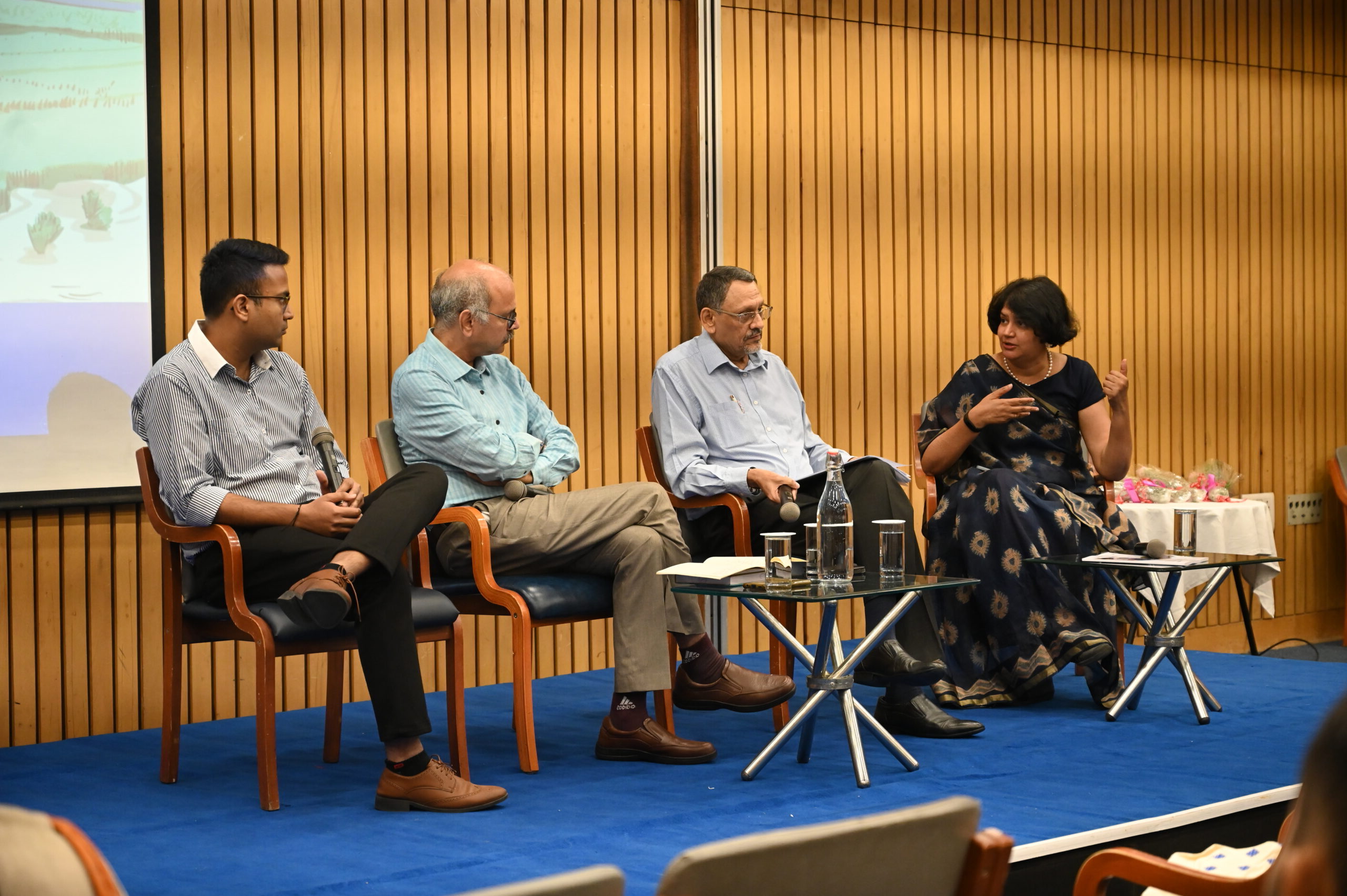
WELL Labs Launch Event Proceedings: Research and Innovation for an Uncertain Future
Water, Environment, Land and Livelihoods (WELL) Labs was formally launched on July 26, 2023, at the India International Centre in New Delhi. This document summarises the keynote lecture and the pan...
-

Reflections on WELL Labs’ Journey: Year in Review and the Path Ahead
How do we solve environmental and social challenges at a large scale? We identified four challenges the social impact sector needs to address.
-

How WELL Labs Is Using Systems Transformation to Solve Complex Water Challenges in India
Water challenges are multi-faceted and involve zero-sum games. Addressing them requires a structural shift in how interconnected economic, social, and ecological systems function
-

Empowering Local Decisions with Isotope Hydrology: A New Frontier for India’s Water Strategy
Upscaling isotope hydrological techniques in water resources management through government policies can help address water challenges in urban and rural India
-
Staying Mission-Oriented in a Project-Funded World
WELL Labs is three years old. Veena Srinivasan, our Executive Director, writes about the journey, and what we have learnt from it in a series of blogs. This is part one of seven.
-

Matching External Commitments to Internal Accountability
In part two of this seven-part series on learnings from three years of running WELL Labs, Veena Srinivasan shares how the organisation stays accountable.